Currently → Week 16 P2 Reviews Week 2
- P2 Drawing Machine (artificial) Final Presentations week 2
- Check the class document for more details on critique format
- Class Exhibition Update
- Please submit a class archive to Chris (chamamoto@snu.ac.kr), Dong Gun (donggunkim93@snu.ac.kr) and Marla (mina_1230@snu.ac.kr) via WeTransfer by Dec 19. This should include photos / screenshots / screen recordings, a short description of your project, and any presentation materials you shared before (PDF, etc.)
- For those participating, prepare your work for the class exhibition December 19-21
Visual Design
Computation
Seoul National University
College of Fine Arts, Department of Design
Fall 2025
Sept 1 → Dec 14, 2022
Tues 2:00pm-5:50pm
Building 49, Room 215
Instructor: Chris Hamamoto
Office hours: Fri 10am – 2pm, building 49 room 207 by appointment
Contact: chamamoto@snu.ac.kr
Grad TA: Dong Gun Kim
Contact: donggunkim93@snu.ac.kr
Undergrad TA: Marla Khudree
Contact: mina_1230@snu.ac.kr
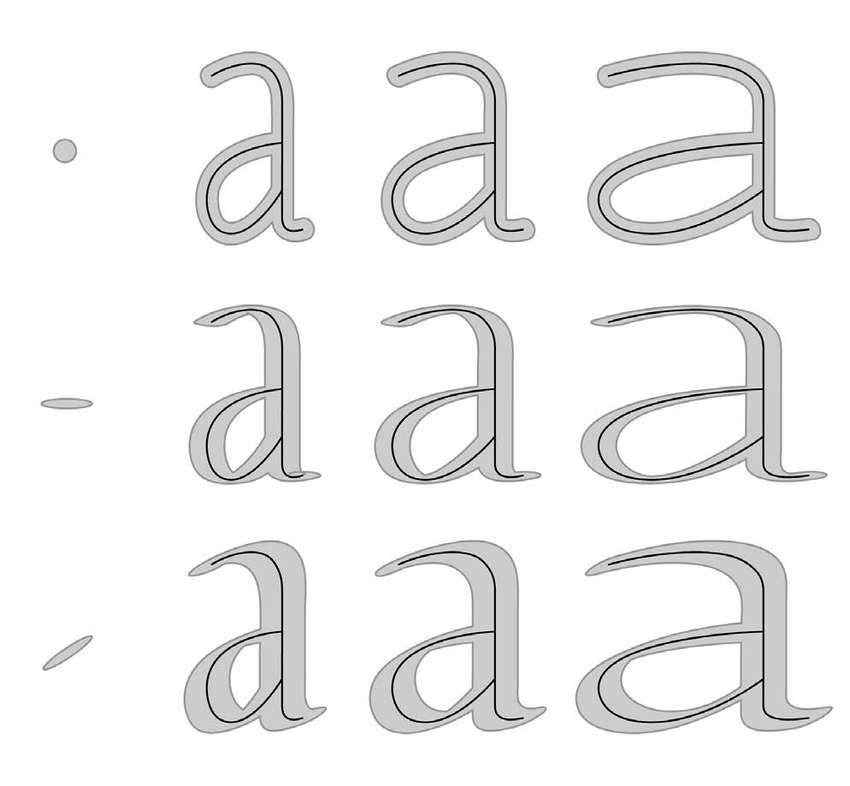
Knuth's meta-font, based on a relative independence between the ductus and the features of the signs. Image by Ernesto Peña
At the turn of the century Computation became a much discussed component of Visual Design. With the movement of "Creative Coding",1 a discourse around the role of code in design took hold, with countless discussions of whether or not "designers should code?"2 ensuing. And while visual design practice fundamentally changed including how we think about logo design3, form-making, information visualization, font design4, and more, these discussion often lose sight of both the long history of computers in design and the role of computational thinking in Graphic Design practice.
While access to tools and the development of software such as Processing had a huge impact on Visual Design, computational ideas are core to modern design, and were discussed long before the PC.5 Furthermore, art-making practices such as Conceptual Art – also influenced by the development of computers - set a foundation for computational thinking in visual works.6
In this course we will consider the use of computation in visual design and we will review and test generative design tools, programming languages, and AI software to create Graphic Designs. However, the courses' main focus is to leverage computational methods, regardless of the computer, for creative outcomes. Simply put, we'll learn some programming, but this courses emphasis will be conceptual and theoretical.
- Wikipedia entry for "Creative Coding"
- "should designers code?" search query on reddit
- Brand New Worlds, Andrew Blauvelt
- COMPUTED TYPE DESIGN, Christop Knoth
- Designing programmes, by Karl Gerstner on The Internet Archive
- Information, NY MoMA, 1970
Learning Outcomes
- Develop Computation based design methods
- Learn coding principles and procedural thinking
- Experiment with programming for visual design – specifically p5.js and Touchdesigner
- Test different AI tools for visual design outcomes
Requirements
Students should be comfortable using design software and producing graphic outcomes (these can range from digital outcomes like webpages or videos, to physical materials such as books, posters, textiles, etc.), and will need to install a VS Code and Touch Designer on your computer.
- Personal Laptop
- Phone, digital camera, scanner, screen capture etc.
- Access to printers and other means of production
Readings
- There will be routine readings with discussions taking place in class and occassionally online. All students will be required to pose one question and respond to another students question about each reading.
Class Activities
The following activities will take place in-person and online via a number of platforms:
- Reading discussion
- Topic lecture/discussion
- Pair programming
- Project critique/discussion
- Group exercises
- A Workshop (potentially held outside of class time)
- One-on-one meetings
- Group meetings
Grading
- 60% ... Projects (There will be 2 individual projects this semester each counting for 30% of your grade)
- 10% ... Assignments (Exercises, readings, etc.)
- 10% ... Workshop
- 20% ... Attendance + Participation/Attitude (Being present and active in class via discussion, and preparation)
Letter grades represent the following:
A = excellent;
B = good;
C = satisfactory;
D = unsatisfactory;
F = failure.
Grading Criteria
Individual project grades and final course grade takes into consideration:
- Participation (attendance, engagement in critique, pro-active involvement through the demonstration of discussion and inquiry)
- Process (exploration, iteration, research)
- Concept (thought, originality, creativity, and criticality)
- Design (does the work function as intended, does it communicate, is there clarity of information and intent)
- Presentation (quality of craft, attention to detail, professionalism)
A note about progamming – your grade won't be based on your coding skill. Instead the hope is you can embrace coding ideas on and off the computer. And think creatively about using simple code to create more complex and visually intriguing works.
Attendance
Students who are absent for over 1/3 of the class will receive a grade of 'F' or 'U' for the course. (Exceptions can be made when the cause of absence is deemed unavoidable by the course instructor.)
Plagiarism
Students are expected to generate their own work and ideas. Since, this class focuses on a range of ideas including appropriation, there can be some gray area about originality in this context. If you are concerned about the authorship of your work, please discuss with chris.
AI
For some assignments use of AI will be the focus and expected. For coding assignments, it is ok to use AI as a supplementary tool, but a goal of the class is to develop fundamental programming skills. So, please do not use AI as a first resort to make code for you, but instead as a debugging tool.
Credits
This website runs on Kirby and was adapted from a site developed by Laurel Schwulst.